The Dog Days of Dog Years

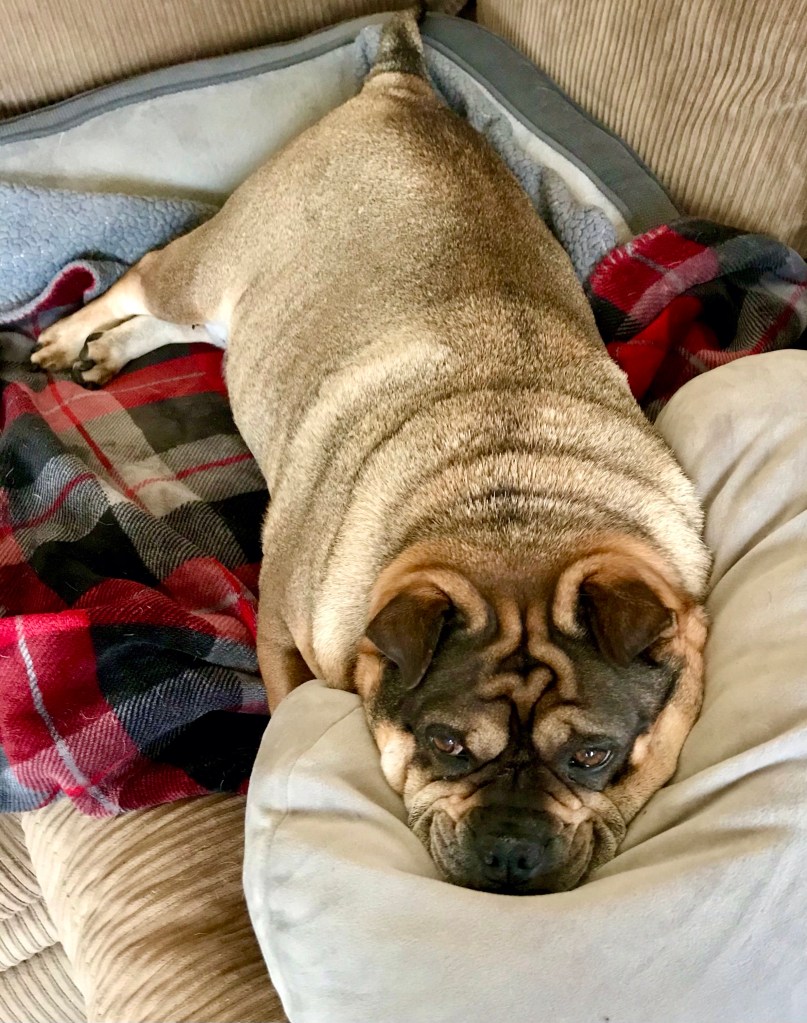
Today, I’m mourning the passing of my beloved dog, Cooper. On his 15th birthday. Even though he’s alive (albeit barely kicking) and sitting next to me lapping up a half-scoop of vanilla bean ice cream after rejecting the just-for-pooches brand I bought for the occasion.

OK; so he’s not gone. Not yet. But I know he’s overshot his average life expectancy by five years. I know he’s got a gradually collapsing trachea — a common ailment of old dogs, I’m told — that’s slowly cutting off his ability to breathe and leads to some disturbing fits of hacking and gasping. I know that I spend a small fortune on opioids and anti-inflammatories to quiet the pain in his grinding joints, and even so, there are plenty of days when it’s a slow, agonizing crawl out of his orthopedic bed.

The writing is on the wall: Sometime between now and his 16th birthday, I’m going to have a hard decision to make, if Mother Nature doesn’t make it for me. And the thought of it is torturing — a red-hot branding iron in the shape of an unknown date searing my heart. I love this dog with my full being. I’ve seen him through the mistrust that came with being passed from home to home in his first year, the challenge of learning to live with a cat invited into his last home without his say-so, the bigger challenge of losing the cat and his cuddle-buddy some years later and a steady physical decline in recent years. He’s seen me through a brutal divorce, depression, the worry and angst of parenting a teenager, the sadness of an empty nest, the loss of the cat and the loneliness of pandemic isolation. I prefer him to most people.

At the moment, we’re both sitting on the deck, winding down from the subdued excitement of presents and treats to mark the milestone — which, c’mon, is impressive. He’s made it to 105 in dog years, if we’re to believe the 7-to-1 trope. But it’s been only a dozen years and some change for me, and they’ve gone by quicker than I would have ever imagined.

It’s been 14 years since I first laid eyes on him. He was already a year old and was on his way to the shelter after the last family he landed with found out they were expecting more than one baby, stealing any time they would have had to care for a puppy. The family happened to be neighbors of a coworker of mine, who casually asked if I might be interested in getting a dog. No, I said; I didn’t think I was. But after hearing Cooper’s impending fate and seeing a snapshot of his adorable, smiling face (don’t argue with me; he does smile), I agreed to meet with this pug/Chinese shar pei mix to see if we were a match.

He went home with me that day.
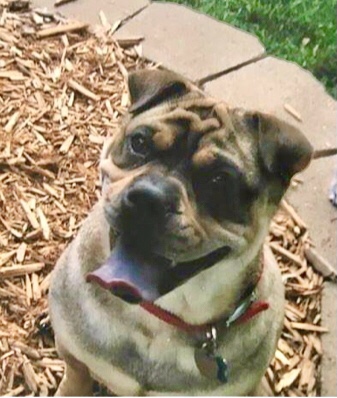
Cooper as he neared his first birthday.

The first year was a challenge. Mine was his fourth home in a year, and he suffered crushing separation anxiety. This led him to tear into inanimate objects anytime he was left alone in the house. Within the first month, he destroyed a sofa and two upholstered chairs. I don’t subscribe to leaving dogs in cages, so I faced the destruction with calm instruction and a determination to ride it out. I duct taped the shredded couch back together. I would come home and find it ripped open again. I would cover the furniture’s wounds with blankets, only to discover the blankets torn to ribbons. Eventually, he stopped going after the furniture and would settle for a pillow here and there. He preferred goose down, and at least three times I walked in the door to find an explosion of feathers covering the furniture, counters and every square inch of floor.

After several months, he got comfortable in his new surroundings and began to trust that I would return whenever I walked out the door. After a little more than a year, I trusted him enough to replace the wrecked couch and chairs with a brand new sectional, and we never looked back.

Looking at him now, it’s hard to believe how much energy he brought in his first 7 or 8 years here. He loved to run circle sprints in the yard, fast as he could go, biting at the grass and stopping suddenly with his front “elbows” on the ground and his tail high, wagging in the air — an invitation to try to get the impossibly slow humans to join him. We could walk for miles around the neighborhood and along a nearby creek, with me calling it quits long before he was ready. He would regularly take the three concrete steps from the front porch in a single bound, and would take a flying leap off the 4-foot retaining wall in the front yard to chase feral cats back into the street runoff drains in which they lived.

These days, climbing the three steps to the porch is a slow, arduous shuffle. Recently, he wandered over to the retaining wall, put his front paws on the ledge, stretched up to his full height and peered over, as though he was thinking about trying the jump — just one more time, for old-time’s sake. Then he sighed — so help me God, it was a sigh — retreated, and ambled back toward the porch.

I first recognized the signs of decline around age 9 or 10, noting it had been a while since he had zoomed around the yard or bounded off the front steps. His vet noted that the joints in his back right leg were getting “crunchy,” and suggested a supplement to help preserve them.

Since then, he’s graduated from supplements to CBD to an injectable anti-inflammatory used on racehorses and a narcotic powerful enough to make the DEA’s list of controlled substances. I’ve progressed from setting up doggy stairs to the bed, to a ramp for the couch, to a full-body sling that I use nightly to carry his 50 pounds up to the second floor, as any attempt to mount the stairs himself elicits pain-wracked whimpers and yelps. It’s been at least three years since he managed so much as a trot, much less a run.

So, I’m in mourning, because the end of his life is imminent. Oh, I don’t have a crystal ball. It could be another year, if you believe in miracles. It could be tomorrow, if you believe in jinxes. But it most likely will be in the next few months, if you believe his medical chart and increasingly labored breathing.

We’re not dwelling on that right now. Right now, I’m enjoying watching him enjoy his ice cream. He takes a break every few seconds, sometimes slobbering my arm with a chilly lick that I’m certain is meant to show gratitude. In return, I rub his ears and coo about what a good dog he is. He can’t hear me. I’m told he can see only a cloudy version of me through the cataracts. But his sense of smell is as good as it ever was, and after the ice cream, we’ll take a laboriously slow stroll down the street, stopping every few feet to sniff out whatever dog or cat or raccoon or rabbit has been there before him.

We make the trip every day, sometimes twice a day. He can only take about 2,000 feet at a time. It’s been several months since I hauled him around the entire block. That took 90 minutes, and I really thought I was going to have to carry him on the last leg from the corner. Shorter is better. But we’ll keep walking, and sniffing, even if it’s only to the mailbox and back, as long as he can keep doing it. Because it makes him happy. And I intend to make him as happy as a 15-year-old dog can be in the time he has left.

It’ll still be a pretty lopsided exchange. Whatever contentment I can offer him over the coming months will never come close to the joy he has brought me over his lifetime. He is the ultimate Good Boy.

One racks up some war stories in 105 years. Even if they’re dog years. I intend to tell some of those stories in the coming weeks — a sort of retro-journal of one Good Boy’s life. I hope you’ll bear with me on that ride.

Vale, Mi Amice

The trip around the lake this morning was more of a stroll than a walk, and ended up as more of a mosey than a stroll. I blame the mid-July heat and blanket of humidity, even at this early hour.

While not quite as oppressive, the heavy air carries distinctive steamy notes of home in the Mississippi Delta. And reminds me of an editor I had back in Cleveland, Mississippi, who has been heavy on my mind in recent days. Mostly I’ve been remembering his love of nature, his dislike of the heat, and the way he collated the two by declaring that God allowed such stifling conditions to give us an appreciation for winter and the wonder of air conditioning. Wayne Nicholas made a career of such quips.

Wayne was the first editor I ever had. He came to the job reluctantly.

His doubt was warranted. I had zero experience as a reporter. Zero. Wayne had already earned dozens of journalism awards by the time I walked into his newsroom at The Bolivar Commercial more than 25 years ago seeking a news photographer’s job, for which I also had zero experience. But at least I had a camera and some photography classes under my belt. The publisher informed me the photo job had been filled, but could I write? The paper was desperate for a reporter (oh, for the days). I was hired after producing about a dozen recent letters to the editor of larger newspapers.

My first day on the job, Wayne was blunt. The ability to cobble together some words for an opinion piece did not a reporter make, he said. Had it been up to him, he said, he would not have hired me. I was not qualified for the job, he said. 

He was, of course, right.

My unearned hiring meant that in addition to writing editorials and assigning, vetting, copy editing and arranging each day’s stories, he had a new chore: Make sure the new girl didn’t screw up too badly.

He accepted this new duty without complaint (at least, to me). He would be fair, but candid. 

On my second day, he handed me a 3-inch thick, 600-page AP Stylebook with the simple instruction of, “Here; memorize this.”

My first week, he put me on a strict assignment of writing obituaries. When I was done with each day’s lot, he’d comb through them with a copy editor’s eye for error. He found plenty. Like when I got the abbreviation of a state wrong. When I used a numeral that should have been written out. When my syntax was off.

He would have me stand over his shoulder as he edited. It took years for me to understand he did this at the expense of his personal comfort. It would have been so much easier to throw a marked-up edit on my desk. But Wayne wanted me to learn. And that meant giving up some of the few remaining and precious slivers of his own time. He was not one to take shortcuts.

When he’d find a mistake, he would punctuate it by peering over his reading glasses at me and saying, “That was just an oversight, right? You know that St. Louis is a stand-alone city and that you don’t need a state designator with it, right?”

I would fudge, as I understood he expected me to do, and say that, of course, it was just an oversight. 

I had a lot of oversights.

Over the following months, he taught me to favor the active voice over the passive. He instructed — more than once and with a healthy dose of sarcasm — that the lede of a story typically belongs in the first paragraph. He cautioned against using “claim” for “said” in attribution, as the former could connote distrust in the source’s truthfulness. And we would not want to do that, because — central to his tutelage — ours is not to sway the reader, but to inform the reader.

I had been on the job a couple of weeks when I got my first real assignment — a feature piece I can’t even recall. But after Wayne gave it a once-over the morning of publication, he turned to me and said, with some surprise, “This reads like a wire story.”

I was thrilled. A wire story! I was too green to understand he wasn’t doling out high praise; he was acknowledging I’d somehow managed to grasp the most basic of story structures: the inverted pyramid. But he did start to give me more news-heavy assignments.

I had been on the job maybe two months when someone disputed a quote I had attributed to her. In a panic, I dug through my notebook and pulled out the jotted quote — with the woman’s name beside it, and hustled to Wayne’s desk to show him, trying not to cry. He didn’t even glance at it.

“If you tell me that you’re certain you got it right, then I’ll go to my grave certain of it, too,” he said, holding my weepy gaze over his glasses. “You’re going to run into a lot of people who will suffer buyer’s remorse after their words hit the paper. If you’re going to be a reporter, you’re going to have to grow a thicker skin.”

“But hold on to your notebooks for at least a couple of years.,” he added as he turned back to his work.

I had been on the job three months when the newspaper’s longtime columnist left for a bigger market. I asked for the slot — again, too wet behind the ears to understand the audacity of such a request from someone who’d paid so little dues. Wayne seemed to take my naiveté for chutzpah, and laughingly said that if I could get the publisher’s OK, I could give it a shot. He grinned and shook his head in wonder when the publisher gave me a trial run. Looking back, I think it tickled Wayne to watch me toddle and stumble my way around the learning curve of an art he had committed to muscle memory decades earlier. Like a parent seeing the jubilation of a child on Christmas morning, he delighted in watching me absorb the lessons he taught and relish new challenges. I think it reminded him of a time when reporting and writing brought joy — before the job and people and life had a chance to forge that tender beginner’s wonder into something sharp and jaded. Everyone who stays in the business any length of time ends up hardened by it.

A little more than a year later, with a regular weekly column and a first-place Mississippi/Louisiana APME award for it, Wayne declared I would one day win a Pulitzer Prize for editorial writing. He was glad, he said, that his misgivings had been wrong. And he was glad that I had shown up — green as I was — in his newsroom. This was high praise, and I reveled in it.

More than a quarter-century later, I’m still using the lessons he taught me. I could fill a book on what I learned about reporting, writing and editing from Wayne in those first years of my career. The fact that I can even call it a career is a credit that belongs mostly to him. He could have decided to run me out of that newsroom, and it wouldn’t have been hard to do. That he opted instead to give me a fighting chance is a testament to the man’s gracious nature.

Last week, I got word that Wayne had died at home. He had long since retired from the newspaper, and was living out his days on the property he had outside of town. I’m ashamed to say it had been almost two decades since I had spoken to him. Even when I worked for him, I only really knew him as a newsman — only scratching the surface of the person he was. At 23, I saw him as an old man. As it turns out, he was a couple of years older than I am now. Which is old, to a 23-year-old.

 I knew he was a religious man who had built a small chapel behind his house, but was unaware he was also an avid stamp collector. I knew he had served in Vietnam, but didn’t know he had earned a Bronze Star for that service until I read it in his obituary. And I knew he was a bird-watcher who loved nature and the outdoors, but I didn’t know we shared a loved of gardening.

He would have loved this lake, with its cranes and herons, its Canada geese and wood ducks; meadowlarks and warblers. 

I wish he could have seen it. I wish I had thought to loop him in when I launched this blog. I wish I had told him what an important part he played in my wanting to be a writer and in shaping my career. I wish I had stayed in touch. I wish I’d been a better friend. And I really wish he’d been right about that Pulitzer.

Farewell, my friend. Deus noster refugium et virtus.