What a Doll …

My trip around the lake today will be dedicated to communing with my grandmother, Doll. It’s been two weeks since she’s passed, and I figure that’s given her enough time to get settled. I miss her every day.
In the meantime, here’s her obituary that I should have posted earlier:

Katherine Anne Milburn passed Monday, Nov. 8, the way we all hope to go: Peacefully in her bed, well into her golden years. She was 91.
Anne was known to her family (as well as many friends and acquaintances in her later years) as “Doll,” and lived up to the name with an enduring gracious and enchanting spirit. She was not one to boast, but the same cannot be said of her family, who have — to a person — taken great pride in their relation to her.
She was a stunner — as beautiful on the inside as she was in the flesh, and whip-smart to boot. She had a career keeping books for a slew businesses, knocked out a crossword puzzle every day, and was a shark at the bridge table. Those who had the good fortune to call her a friend knew her to be exceptionally kind and generous, and descriptions of her often included “lovely” and “fine” and “genteel.”
One of the highest compliments paid her was that she was “always the same sweet and generous person — whether in bad times or good.”
Anne was born on Feb. 7, 1930, in Greenwood, Miss., to Roy and Wray (née Wyse) Evans. She lived her entire life in Mississippi, growing up in Greenwood and moving as a teenager to Greenville, where she graduated from E.E. Bass High School in 1947. She moved to Ruleville after marrying Richard “Dick” Milburn and lived there for 50 years, where she was a fixture at the Ruleville First United Methodist Church, its choir, the United Methodist Women and the 20th Century Club. She volunteered her time with the local library, as a poll worker, and with the cemetery board.
It wasn’t until her mid-80s that she left the Mississippi Delta to move to Oxford, where she went about charming the locals as effortlessly as she had in the Delta, joining the David Reese Chapter of the Daughters of the American Revolution.
She was, and is, beloved by her family and leaves a void that cannot be filled.
She was preceded in death by her husband; oldest son, William Ross Smith, Jr.; and sister, Margaret Rose Holloway.
She is survived by her youngest son, Richard Hayden Smith, and daughter-in-law, Emily Smith, of Cleveland; daughter-in-law Virginia Smith Young, of Oxford; brother Roy Dudley Evans, of Bassfield; nieces Alice Sanders, of Kosciusko; Susan Guercio (Mike), of Venice, Fla.; and Linda Bradshaw (Sunny), of Fairhope, Ala.; five grandchildren and 16 great-grandchildren.

The Dog Days of Dog Years

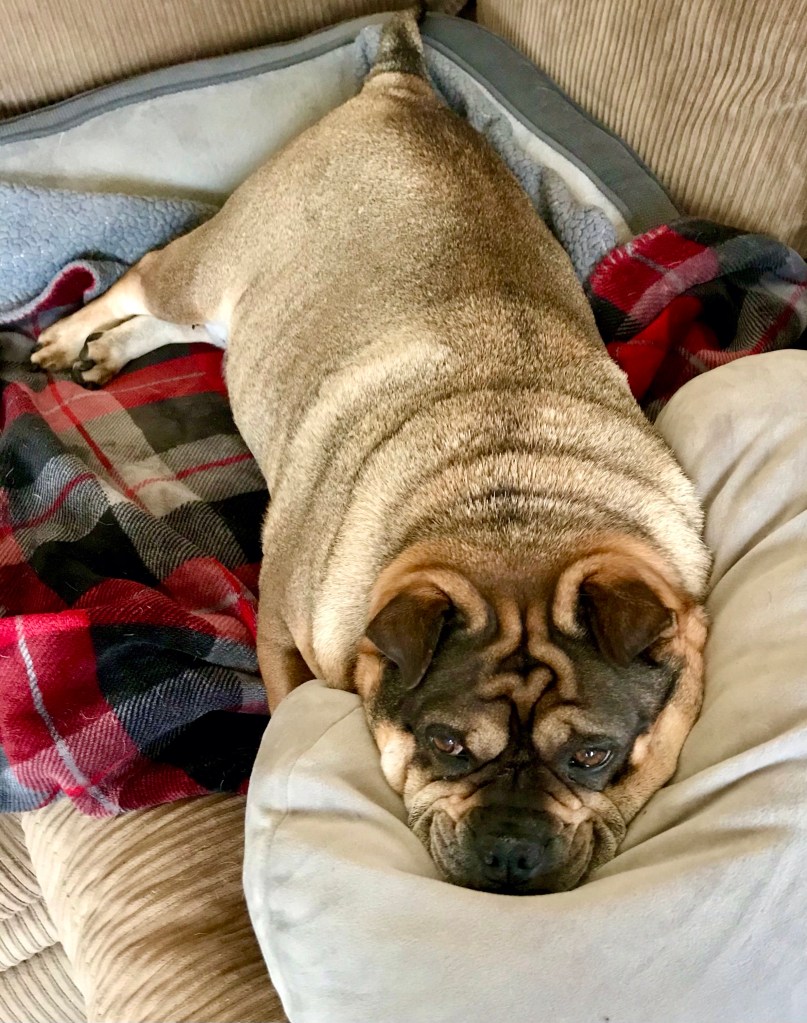
Today, I’m mourning the passing of my beloved dog, Cooper. On his 15th birthday. Even though he’s alive (albeit barely kicking) and sitting next to me lapping up a half-scoop of vanilla bean ice cream after rejecting the just-for-pooches brand I bought for the occasion.

OK; so he’s not gone. Not yet. But I know he’s overshot his average life expectancy by five years. I know he’s got a gradually collapsing trachea — a common ailment of old dogs, I’m told — that’s slowly cutting off his ability to breathe and leads to some disturbing fits of hacking and gasping. I know that I spend a small fortune on opioids and anti-inflammatories to quiet the pain in his grinding joints, and even so, there are plenty of days when it’s a slow, agonizing crawl out of his orthopedic bed.

The writing is on the wall: Sometime between now and his 16th birthday, I’m going to have a hard decision to make, if Mother Nature doesn’t make it for me. And the thought of it is torturing — a red-hot branding iron in the shape of an unknown date searing my heart. I love this dog with my full being. I’ve seen him through the mistrust that came with being passed from home to home in his first year, the challenge of learning to live with a cat invited into his last home without his say-so, the bigger challenge of losing the cat and his cuddle-buddy some years later and a steady physical decline in recent years. He’s seen me through a brutal divorce, depression, the worry and angst of parenting a teenager, the sadness of an empty nest, the loss of the cat and the loneliness of pandemic isolation. I prefer him to most people.

At the moment, we’re both sitting on the deck, winding down from the subdued excitement of presents and treats to mark the milestone — which, c’mon, is impressive. He’s made it to 105 in dog years, if we’re to believe the 7-to-1 trope. But it’s been only a dozen years and some change for me, and they’ve gone by quicker than I would have ever imagined.

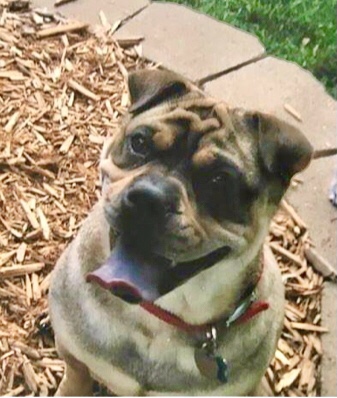
It’s been 14 years since I first laid eyes on him. He was already a year old and was on his way to the shelter after the last family he landed with found out they were expecting more than one baby, stealing any time they would have had to care for a puppy. The family happened to be neighbors of a coworker of mine, who casually asked if I might be interested in getting a dog. No, I said; I didn’t think I was. But after hearing Cooper’s impending fate and seeing a snapshot of his adorable, smiling face (don’t argue with me; he does smile), I agreed to meet with this pug/Chinese shar pei mix to see if we were a match.

He went home with me that day.

Cooper as he neared his first birthday.

The first year was a challenge. Mine was his fourth home in a year, and he suffered crushing separation anxiety. This led him to tear into inanimate objects anytime he was left alone in the house. Within the first month, he destroyed a sofa and two upholstered chairs. I don’t subscribe to leaving dogs in cages, so I faced the destruction with calm instruction and a determination to ride it out. I duct taped the shredded couch back together. I would come home and find it ripped open again. I would cover the furniture’s wounds with blankets, only to discover the blankets torn to ribbons. Eventually, he stopped going after the furniture and would settle for a pillow here and there. He preferred goose down, and at least three times I walked in the door to find an explosion of feathers covering the furniture, counters and every square inch of floor.

After several months, he got comfortable in his new surroundings and began to trust that I would return whenever I walked out the door. After a little more than a year, I trusted him enough to replace the wrecked couch and chairs with a brand new sectional, and we never looked back.

Looking at him now, it’s hard to believe how much energy he brought in his first 7 or 8 years here. He loved to run circle sprints in the yard, fast as he could go, biting at the grass and stopping suddenly with his front “elbows” on the ground and his tail high, wagging in the air — an invitation to try to get the impossibly slow humans to join him. We could walk for miles around the neighborhood and along a nearby creek, with me calling it quits long before he was ready. He would regularly take the three concrete steps from the front porch in a single bound, and would take a flying leap off the 4-foot retaining wall in the front yard to chase feral cats back into the street runoff drains in which they lived.

These days, climbing the three steps to the porch is a slow, arduous shuffle. Recently, he wandered over to the retaining wall, put his front paws on the ledge, stretched up to his full height and peered over, as though he was thinking about trying the jump — just one more time, for old-time’s sake. Then he sighed — so help me God, it was a sigh — retreated, and ambled back toward the porch.

I first recognized the signs of decline around age 9 or 10, noting it had been a while since he had zoomed around the yard or bounded off the front steps. His vet noted that the joints in his back right leg were getting “crunchy,” and suggested a supplement to help preserve them.

Since then, he’s graduated from supplements to CBD to an injectable anti-inflammatory used on racehorses and a narcotic powerful enough to make the DEA’s list of controlled substances. I’ve progressed from setting up doggy stairs to the bed, to a ramp for the couch, to a full-body sling that I use nightly to carry his 50 pounds up to the second floor, as any attempt to mount the stairs himself elicits pain-wracked whimpers and yelps. It’s been at least three years since he managed so much as a trot, much less a run.

So, I’m in mourning, because the end of his life is imminent. Oh, I don’t have a crystal ball. It could be another year, if you believe in miracles. It could be tomorrow, if you believe in jinxes. But it most likely will be in the next few months, if you believe his medical chart and increasingly labored breathing.

We’re not dwelling on that right now. Right now, I’m enjoying watching him enjoy his ice cream. He takes a break every few seconds, sometimes slobbering my arm with a chilly lick that I’m certain is meant to show gratitude. In return, I rub his ears and coo about what a good dog he is. He can’t hear me. I’m told he can see only a cloudy version of me through the cataracts. But his sense of smell is as good as it ever was, and after the ice cream, we’ll take a laboriously slow stroll down the street, stopping every few feet to sniff out whatever dog or cat or raccoon or rabbit has been there before him.

We make the trip every day, sometimes twice a day. He can only take about 2,000 feet at a time. It’s been several months since I hauled him around the entire block. That took 90 minutes, and I really thought I was going to have to carry him on the last leg from the corner. Shorter is better. But we’ll keep walking, and sniffing, even if it’s only to the mailbox and back, as long as he can keep doing it. Because it makes him happy. And I intend to make him as happy as a 15-year-old dog can be in the time he has left.

It’ll still be a pretty lopsided exchange. Whatever contentment I can offer him over the coming months will never come close to the joy he has brought me over his lifetime. He is the ultimate Good Boy.

One racks up some war stories in 105 years. Even if they’re dog years. I intend to tell some of those stories in the coming weeks — a sort of retro-journal of one Good Boy’s life. I hope you’ll bear with me on that ride.

April Fools

If you concentrate during those times you’re alone on the trail, you can almost fool yourself into thinking that nothing has changed.

All alone on the back side of the lake, you can close your eyes and take in the perfume of wet earth and newly sprouted grass. You can, if only briefly, mute your own thoughts and meditate to the dry rustle of a spring breeze through the husks of last year’s prairie grass. Or the gentle lap of the lake against its rock-lined shores. To the whistle and trill of birds seeking to beget a new generation. It’s spring again, you tell yourself. It’s spring again, just like last year and the years before.

You can even pretend with your eyes wide open, for short stretches when no one else is on the trail. You can take in the sights of nature beginning anew. Of gray winter skies and the steel-colored ice that had paved the lake giving way to brilliant blues, signaling Earth’s annual rebirth. But inevitably, your eyes are going to belie the facade of life as usual. They’ll note the odd absence of people on the trail, given that it’s a beautiful spring day. They will observe in that cerulean sky the conspicuous absence of tell-tale contrails of jetliners moving people from one place to the other. Just like 9/11, you think. Just like that gorgeous September day — not a cloud in the sky — when it seemed the world had stopped turning.

Eventually, you’re going to run into other people who, like you, are stretching their legs and escaping their own quarantine. And then you’ll remember. You’ll remember as you both ease to opposite edges of the 8-foot-wide concrete trail in an effort to stay as far from each other as possible. You’ll remember as you nod your greeting instead of verbalizing it, because you wouldn’t want to send a deadly virus in that stranger’s direction if, by chance, you have it. You’ll remember your anxiety that you could have such a deadly virus lurking in you because you dared venture to the store earlier this week for the groceries you need. You’ll remember that this person 6 to 8 feet from you could also be carrying a deadly virus, and might be worried about carrying it home to a spouse or children or parents. You’ll remember.

I had planned on posting an amusing bit today on my two weeks of self-quarantine, in which I kept a daily journal. It was funny. Or, at least, I thought it was. But I can’t seem to work up to funny today. Too much has happened since yesterday. I’ve read too many posts from friends who are nurses and doctors on the front lines and going into battle woefully under-protected from an invisible foe, who have seen enough death in the last week to last them a lifetime, but who are bracing for that death to double several-fold over the coming weeks.

It’s so bad in New York, now the epicenter of the pandemic, that bodies are being loaded into refrigerated trailers serving as make-shift morgues. Triage tents have been set up in Central Park — a reality not seen since the bloodbath of the American Civil War.

The White House acknowledged yesterday that somewhere around 250,000 people in the U.S. could die from the virus — if we do a halfway decent job of staying away from each other. The projections if don’t do a good job are four to eight times that number.

A quarter-million people means you or someone you know is going to die from this pathogen; 250,000 moves the new coronavirus from something that didn’t exist a year ago to the third-leading cause of death in 2020, behind heart disease and cancer. It is more than the number of deaths per year from flu, accidents and homicides, combined. And it doesn’t take into account those people who will die from other maladies untreated — from uncaught cancers to mental illness leading to suicide — as health care workers struggle to both contain this new virus and lose scores of their own in the fight. That many deaths, were it meted out equally, comes to 5,000 deaths in your state. A quarter-million people is a whole new ballgame.

A day later — on April Fools’ Day, no less — we learned that the Chinese government appears to have low-balled its own coronavirus numbers, both of cases and deaths. That takes away some hope that had been built on what appeared to be China’s containment of the virus. Ha! Gotcha, rest of the world!

While the grown-ups have been playing at pretending all is OK, other members of our families are not so discreet. The dogs openly display their confusion on the trail, as they happily rush up to strangers — as dogs are wont to do — for a pat on the head or scruff behind the ear, only to endure a harsh, “NO!” and jerk of the leash. Dogs don’t understand the plague or social distancing or fatality ratios. What they know is that, until recently, there was nothing wrong with a friendly greeting of other people on the trail. 

Young children have the same problem, but can at least verbalize their confusion, which only serves to enhance the surreal circumstances of our current reality.

I had almost finished my recent walk when a girl of about 4 toddled briefly from her family toward me with what looked to be a paper flower in her outstretched hand. I froze, as my desire not to hurt the little girl’s feelings clashed with my understanding that it would be the height of irresponsibility to take something from her hand.

Luckily, her dad intervened.

“Emma, no,” he said. “Remember, we talked about this. We have to stay away from other people, so we don’t get sick.”

The girl stopped and gave me a once over, before turning back to her dad.

“But she looks nice,” the girl protested.

Nervous laughter all around.

“I’m sure she is nice,” the dad said. “But germs don’t care who’s nice. Germs make even nice people sick.”

Indeed, they do. Nice people and jerks; the beautiful and the ugly; intellectuals and fools, alike. We’re all in this together, even as we remain at least 6 feet apart.

Slippery Slope

My observations these days are coming about half a mile up the hill from the lake — the bit of it I can see from my front yard. Like many of you, I’m keeping my distance in the hopes of both not contracting and not spreading a particularly nasty virus.

As part of my job over the last month (has it only been a month? It seems so much longer), I’ve had to brush up on viruses and pandemics and the efforts to combat them. I know that the new coronavirus originated in animals — likely bats or an Asian armadillo-like creature called a pangolin — and at some point last year jumped to humans. It quickly adapted to spread from human to human, and some studies show it continues to morph into deadlier strains. Scientists have a word for this type of virus: slippery.

How apropos. Slippery. It so perfectly captures not only the mutating virus, but the unsure footing of our society, our economy, even our liberties, as we scramble to stop the spread.

I’d hazard a guess that most of us until this month have taken for granted the ability to browse a fully-stocked grocery store at our convenience. Or drop into a restaurant for a bite, our most pressing concern being whether we wanted burgers, Tex-Mex, Italian or fare from an endless array of ethnic offerings.

Now, many of those shelves are bare. The restaurants are closed or offering only take-out. We find ourselves essentially on lockdown, with a domino succession of states and cities issuing stay-at-home orders as officials desperately try to get a handle on a pandemic that has already slipped out of their control. On March 1, there were 75 confirmed cases in the United States, most of them on the West Coast. Today, there are some 34,000 cases across the country and 500 deaths, and those numbers are expected to grow exponentially over the coming days, maybe weeks. The World Health Organization says 20% of those who contract the virus will need to be hospitalized. Projections suggest our hospitals will become overwhelmed if we can’t slow the spread by staying away from each other.

I’m all in on self-isolation. I was asked last week to stay in my home and monitor for symptoms after possibly being exposed two weeks ago. The monitoring was to last a week, but I know I’m in for a longer haul, as are we all. 

I’m lucky; I can work from home. I’m also lucky in that I live alone — just me and the dog. No one in; no one out. No one to inadvertently bring home the pathogen from the store or office or elsewhere. No one to bother me as I work. No one to else to feed. No one else with whom to discuss the world’s current events. No one else to watch television with. No one else to share a meal with. No one else. No one. No. One.

It’s Day 7, and I’m not at all convinced that the deafening silence of my isolation is any less unhinging than the noisy chaos of a tightly-packed house under quarantine. I say that knowing the mother of four down the street reading this would like to raise a point of order.

We may all, over the coming weeks, find ourselves slipping into madness somewhere between tedium and terror.

But as dire as slippery can seem, it’s a far cry from collapsed.

I’m not making light of the predicament we’re in. We are more than just inconvenienced. It’s hard to find staples, from bread to toilet paper. Our children are losing nearly half a year of school. Our medical needs are being put on the back burner as health care workers scramble to triage an outbreak. A lot of us have lost our jobs. Some of us are facing losing our livelihoods. Very slippery stuff.

On the other hand, we have running water. The power is still on. Our societal infrastructure remains largely intact. We’re still streaming Netflix, for heaven’s sake.

I have a childhood friend who was living on the Mississippi Gulf Coast when an enraged Hurricane Katrina came screaming over the shore. It wiped homes, schools and businesses off their foundations, wrecked the power grid and cut off all modern means of communication. Power and phone service were down more than a month in some places. More than 200 Mississippians died in the storm; 67 people were never found.

My friend’s house was among those that survived the winds and storm surge, though it took a beating along with the rest of the property. She and her husband ran a horse farm at the time, and their immediate concerns were to save the horses they could (some didn’t make it) and fix the fences and shelters to keep the animals safe. 

But the need for food, potable water and other essentials soon loomed large. It wasn’t as simple as going to the store; stores were destroyed or unable to take business because there was no power to run the machines. Your credit card was useless. No cash; no goods. Looters turned out in droves, first at stores, then when those ran dry, other people’s homes. With no phones, there was no calling 911 for help. Even if you could, there was often no one to reach. Many emergency responders had abandoned their posts either to flee the devastation or to protect their own families from the lawlessness that overtook those ravaged communities.

It took only days for civilized society to break down into something apocalyptic. 

My friend described an existence over the coming weeks that sounded like something your would read in a horror novel. To protect the house against looters, she and her husband took turns keeping watch at night from the front porch with a small arsenal. So they each got to sleep only every other night. For weeks.

Without power, there was no way to pump fuel needed to keep the generators and farm implements running. Luckily, her dad owned a farm 300 miles north and would fill a tanker on the back of a truck to drive down. But the trip required additional men for when the truck crossed over into what my friend and her neighbors called “The Zone” — a line in the sand where civilization ended and anarchy ruled. Once the truck reached The Zone, the farmhands would take up posts hanging from the outside of the tank with rifles slung over their shoulders. This was to protect precious cargo — literally a tank of gas — from armed hijackers.

My friend recalled this Wild West existence as she pushed green beans around on a plate at a high school reunion dinner, with no more disquietude than if she were recounting her kid’s softball game. Conversely, I’m certain my lower jaw rested on the table as I listened in open-mouthed horror.

“To this day, I feel uneasy going to the grocery store without a sidearm,” she said matter-of-factly, while wearing a cocktail dress and sipping a nice pinot grigio. This was two years after Katrina.

I’ve thought of this exchange a lot in the last week, as this slippery virus puts our lives on a slippery slope of upended routines and financial uncertainty. It’s dicey, yes. But not destroyed. Barring something unforeseen, there is no Thunderdome in our future.

What I’ve seen from the seat at my front window is a good dose of patience. I’ve seen inventive minds working to provide needed supplies to the front lines of those fighting the pandemic. I see neighbors helping neighbors. I see people taking action to look out for those who have no loved ones nearby — that includes friends who’ve checked in with me daily. 

And I can still see the lake shimmering in the distance and look forward to soon pondering these times along its winding trail. Stay safe and keep your footing, friends. It’s slippery out there.

Vale, Mi Amice

The trip around the lake this morning was more of a stroll than a walk, and ended up as more of a mosey than a stroll. I blame the mid-July heat and blanket of humidity, even at this early hour.

While not quite as oppressive, the heavy air carries distinctive steamy notes of home in the Mississippi Delta. And reminds me of an editor I had back in Cleveland, Mississippi, who has been heavy on my mind in recent days. Mostly I’ve been remembering his love of nature, his dislike of the heat, and the way he collated the two by declaring that God allowed such stifling conditions to give us an appreciation for winter and the wonder of air conditioning. Wayne Nicholas made a career of such quips.

Wayne was the first editor I ever had. He came to the job reluctantly.

His doubt was warranted. I had zero experience as a reporter. Zero. Wayne had already earned dozens of journalism awards by the time I walked into his newsroom at The Bolivar Commercial more than 25 years ago seeking a news photographer’s job, for which I also had zero experience. But at least I had a camera and some photography classes under my belt. The publisher informed me the photo job had been filled, but could I write? The paper was desperate for a reporter (oh, for the days). I was hired after producing about a dozen recent letters to the editor of larger newspapers.

My first day on the job, Wayne was blunt. The ability to cobble together some words for an opinion piece did not a reporter make, he said. Had it been up to him, he said, he would not have hired me. I was not qualified for the job, he said. 

He was, of course, right.

My unearned hiring meant that in addition to writing editorials and assigning, vetting, copy editing and arranging each day’s stories, he had a new chore: Make sure the new girl didn’t screw up too badly.

He accepted this new duty without complaint (at least, to me). He would be fair, but candid. 

On my second day, he handed me a 3-inch thick, 600-page AP Stylebook with the simple instruction of, “Here; memorize this.”

My first week, he put me on a strict assignment of writing obituaries. When I was done with each day’s lot, he’d comb through them with a copy editor’s eye for error. He found plenty. Like when I got the abbreviation of a state wrong. When I used a numeral that should have been written out. When my syntax was off.

He would have me stand over his shoulder as he edited. It took years for me to understand he did this at the expense of his personal comfort. It would have been so much easier to throw a marked-up edit on my desk. But Wayne wanted me to learn. And that meant giving up some of the few remaining and precious slivers of his own time. He was not one to take shortcuts.

When he’d find a mistake, he would punctuate it by peering over his reading glasses at me and saying, “That was just an oversight, right? You know that St. Louis is a stand-alone city and that you don’t need a state designator with it, right?”

I would fudge, as I understood he expected me to do, and say that, of course, it was just an oversight. 

I had a lot of oversights.

Over the following months, he taught me to favor the active voice over the passive. He instructed — more than once and with a healthy dose of sarcasm — that the lede of a story typically belongs in the first paragraph. He cautioned against using “claim” for “said” in attribution, as the former could connote distrust in the source’s truthfulness. And we would not want to do that, because — central to his tutelage — ours is not to sway the reader, but to inform the reader.

I had been on the job a couple of weeks when I got my first real assignment — a feature piece I can’t even recall. But after Wayne gave it a once-over the morning of publication, he turned to me and said, with some surprise, “This reads like a wire story.”

I was thrilled. A wire story! I was too green to understand he wasn’t doling out high praise; he was acknowledging I’d somehow managed to grasp the most basic of story structures: the inverted pyramid. But he did start to give me more news-heavy assignments.

I had been on the job maybe two months when someone disputed a quote I had attributed to her. In a panic, I dug through my notebook and pulled out the jotted quote — with the woman’s name beside it, and hustled to Wayne’s desk to show him, trying not to cry. He didn’t even glance at it.

“If you tell me that you’re certain you got it right, then I’ll go to my grave certain of it, too,” he said, holding my weepy gaze over his glasses. “You’re going to run into a lot of people who will suffer buyer’s remorse after their words hit the paper. If you’re going to be a reporter, you’re going to have to grow a thicker skin.”

“But hold on to your notebooks for at least a couple of years.,” he added as he turned back to his work.

I had been on the job three months when the newspaper’s longtime columnist left for a bigger market. I asked for the slot — again, too wet behind the ears to understand the audacity of such a request from someone who’d paid so little dues. Wayne seemed to take my naiveté for chutzpah, and laughingly said that if I could get the publisher’s OK, I could give it a shot. He grinned and shook his head in wonder when the publisher gave me a trial run. Looking back, I think it tickled Wayne to watch me toddle and stumble my way around the learning curve of an art he had committed to muscle memory decades earlier. Like a parent seeing the jubilation of a child on Christmas morning, he delighted in watching me absorb the lessons he taught and relish new challenges. I think it reminded him of a time when reporting and writing brought joy — before the job and people and life had a chance to forge that tender beginner’s wonder into something sharp and jaded. Everyone who stays in the business any length of time ends up hardened by it.

A little more than a year later, with a regular weekly column and a first-place Mississippi/Louisiana APME award for it, Wayne declared I would one day win a Pulitzer Prize for editorial writing. He was glad, he said, that his misgivings had been wrong. And he was glad that I had shown up — green as I was — in his newsroom. This was high praise, and I reveled in it.

More than a quarter-century later, I’m still using the lessons he taught me. I could fill a book on what I learned about reporting, writing and editing from Wayne in those first years of my career. The fact that I can even call it a career is a credit that belongs mostly to him. He could have decided to run me out of that newsroom, and it wouldn’t have been hard to do. That he opted instead to give me a fighting chance is a testament to the man’s gracious nature.

Last week, I got word that Wayne had died at home. He had long since retired from the newspaper, and was living out his days on the property he had outside of town. I’m ashamed to say it had been almost two decades since I had spoken to him. Even when I worked for him, I only really knew him as a newsman — only scratching the surface of the person he was. At 23, I saw him as an old man. As it turns out, he was a couple of years older than I am now. Which is old, to a 23-year-old.

 I knew he was a religious man who had built a small chapel behind his house, but was unaware he was also an avid stamp collector. I knew he had served in Vietnam, but didn’t know he had earned a Bronze Star for that service until I read it in his obituary. And I knew he was a bird-watcher who loved nature and the outdoors, but I didn’t know we shared a loved of gardening.

He would have loved this lake, with its cranes and herons, its Canada geese and wood ducks; meadowlarks and warblers. 

I wish he could have seen it. I wish I had thought to loop him in when I launched this blog. I wish I had told him what an important part he played in my wanting to be a writer and in shaping my career. I wish I had stayed in touch. I wish I’d been a better friend. And I really wish he’d been right about that Pulitzer.

Farewell, my friend. Deus noster refugium et virtus.
On the Waterfront

I chickened out on my first trip to the water.

The stink of polyvinyl hung heavy in the minivan, thanks to the inflatable kayak crammed into it, with the vessel’s nose squeezed between the two front bucket seats and blocking much of my view. I had bought the blow-up kayak on sale after learning that the much-anticipated lake to the north would be opening that week. I inflated the thing in my living room to test that it didn’t have a leak. After being assured it did not, I dragged it through the house, awkwardly navigating it through two doors and into the garage and shoving it into the hatchback end of the van. I mean, it was already inflated. I didn’t see the point of deflating it only to re-inflate it three minutes later at the lake.

I opted for the inflatable raft over a hard-shell kayak because 1.) It was cheaper; 2.) I didn’t know how to strap a kayak to the roof of the van; and 3.) I wanted to test the water, so to speak, to see if I’d actually use it on a regular basis before committing a chunk of the garage to a 10 foot span of plastic. This way, if I never went kayaking again, I could stuff the deflated thing back in its 3’x2’ box and be done with it.

But here I was, slowly circling the parking lot, chagrined at the sight of others’ fancy kayak trailers and rooftop racks, hoping they couldn’t see the glorified pool float squeezed inside my vehicle. They’d know soon enough when I pulled it out, circus clown style. 

Then there was the question of where and how to actually get it in the lake, and how to get myself into it without flipping over into the water. And was I dressed properly? What does one wear to kayak on a warm summer’s day? A wetsuit with aqua shoes seemed too aggressive for a casual outing in what was essentially a pond. A bathing suit felt too immodest. I settled on capri cargo khakis with a T-shirt and flip-flops. Everyone else who’d come out to paddle the new water was already in, and I couldn’t tell what they were wearing.

The new lake opened in June, some 10 years after it was first proposed. All in all, I would think a decade from concept to paddling a canoe is a pretty quick turnaround, given that nature tends to take at least a few thousand years. Still, it felt like an eternity.

That may be because I moved into the neighborhood nearly a dozen years ago on the promise that the developer would be building a neighborhood pool. 

“Next summer, it’ll be open,” the real estate agent had assured, more than once. It was fall, and the coming winter promised to be brutal. I’d spent that summer juggling work, the kids’ activities and helping remodel my current home’s basement. The prospect of spending the next summer lounging by the pool, catching up on my reading while the kids splashed their way to an early bedtime was a seduction I could not resist.

But unbeknownst to me, my plunge into the next step beyond starter home corresponded with the largest housing market collapse in U.S. history. No pool _ not even a hint of pool construction _ was forthcoming the next summer. There also seemed to be no construction of new homes. Not only did the dozen or so of us who’d bought homes in the fledgling neighborhood not have a pool, we had no new neighbors. For years to come.

Turns out, the developer likely knew _ even by the time we were being sold a bill of goods _ that no pool was set for construction for the next summer. By the summer after that, the developer was well aware there would be no pool at all, but the few neighbors we acquired said agents desperate for a sale had peddled the lie to them that the pool was on the books. There was more than a little anger and angst over this once the con was up. There was talk of a lawsuit and questions about what had been done with years of inflated neighborhood association dues that were supposed to be going into a pool fund. But then came word of the lake, and we all had something bigger and potentially better to distract us.

And now, here I was, hanging in my van and fretting over how to get in the water.

With all this pent-up snobbery over eastern Nebraska’s lack of big water, you’d think I would have no problem getting onto a lake I initially  dubbed “The Duck Pond.” But after circling the lot about three times, I pulled out and went back home.

I left under the guise of needing to get a towel or two to dry off from the soaking I would inevitably get. At least, that’s what I told myself. Plus, it was too crowded at high noon on a Sunday. I loitered at home most of the afternoon.

By the time I worked up the courage to head back, there was still about three hours of daylight left, and the crowd had thinned a bit. I took a deep breath, hauled the inflatable raft out of the van and dragged it to the boat launch. I eased in, used the paddle to push off, and just like that, I was kayaking. I looked around. No one was staring. No one was pointing and laughing at my pool-float of a kayak. No one seemed to be paying attention to my venture at all.

I paddled to the center of the shallow lake, where the crowns of cottonwoods and willows that had lined the original, now-dammed creek rose up from the water’s surface. I’d stop every now and then to take photos with my phone, but otherwise paddled straight through to the far side of the lake until my arms ached _ apparently forgetting that I’d have to paddle back just as far. By the time I returned to the boat launch, my arms and back were as weak and useless as jelly. But I felt alive and accomplished, having made my first solo kayaking trip. Why had I spent even a second worrying that I might look foolish getting into the water?

Then came time to get out of the water.

I slid the inflatable kayak front first up the ramp until the vinyl bottom under me gripped the concrete, coming to a hard stop. Easy-peasy, I thought. I’ll just swing my legs over the side and stand up. It appears I had left some things out of my calculation. Like the fact that I was almost 50. And that I hadn’t attempted a stand-from-a-bottom-on-the-ground move in probably 30 years. And gravity.

I willed myself to stand. I went nowhere. I put a hand under me while holding the paddle in front of me to leverage myself up. I made it about three inches before falling back into the rubber kayak. I tossed the paddle to the bank and put both hands under me to try to push myself up. Still a no-go. After a few pathetic minutes, I had decided my only option was to sit in the thing for several hours until every living soul had left, then roll myself out of the kayak, into the water and crawl my way up the ramp _ when I heard a voice say, “Here; let me give you a hand.”

It was my next-door neighbor, who’s probably about 20 years younger and 30 pounds lighter than me and can definitely stand up from a seated position in a floating kayak. I know this because he had just gotten out of a kayak on the other side of the ramp.

I was past grappling with defeat and awkwardness. I just took the hand he had mercifully reached out, and _ voila! _ I was on my feet. Ten minutes earlier I had felt as outdoorsy and capable as Bear Grylls. Now, I felt like the poster geezer for Life Alert.

Was I embarrassed? You bet. Did it kill me? It did not. Again; no one seemed to care that the old lady in the pool-float kayak needed a hand to get out of it. And I’ve since made some adjustments to avoid a repeat _ like docking on the ramp stern-first to get further on solid ground and more leverage. Wearing shorts, instead of capris, that won’t drag in the water as I get out. And doing some squats every once in a while to build at least a modicum of strength.

I’ve been in the water about a half-dozen times now, still using the inflatable canoe. It’s become one of my favorite pastimes. I’ll likely graduate to a real kayak this year, and install a roof rack to carry it.

I’m glad I didn’t let the fear of looking foolish keep me from trying something new. I’m going to try to remember that when I get on a bike for the first time in a couple of decades later this summer.

On Your Left

There are two kinds of people who use the trail around the lake: the two-footed kind and the two-wheeled kind.

Sure; there’s the occasional rollerblader, but they’re so rare, it’d be impossible to give them their own column. They’re the .03 percent who check “other.” Everyone else on the path is either a walker/jogger or a bicyclist.

Just as with seemingly every other facet of life these days, there’s a sort of tribalism that pits the walkers against the bicyclists on the trail. I mean, we all keep it polite; nod and say our good mornings when we pass each other face-to-face. Most of us, on both sides, fall into a pretty benign category: those, like me, whose hike resembles more of a stroll, and those bicyclists just out to enjoy the weather or traveling in family packs _ mom and dad and a couple of young kids in tow _ moving not much faster than the joggers. 

Then there are the Serious Cyclists. They’re discernible from the rest of us by their spandex body suits, aerodynamic alien-shaped helmets and thin-tired, curled handled bikes. Oh, and their tendency to scream around others on the trail at a blistering speed in their perpetual quest to top last week’s time. The Serious Cyclists are annoyed with walkers and joggers, who could possibly slow what would otherwise surely be the cyclist’s Best Time Ever. Walkers and joggers are equally annoyed by the Serious Cyclist’s sense of entitlement to the trail.

Still _ we keep it civil. But there’s a wariness beneath the surface of our civility. It’s a tacit antipathy born, I suppose, of the very real possibility of someone from either group ending up in a body cast if coexistence on an 8-foot wide path of concrete breaks down.

To keep that from happening, there are rules that must be followed. The rules are posted at various intervals on the trail, reminding walkers to keep to the right side of the path and bicyclists to “announce your presence.”

It seems to me that if I were a cyclist _ which, I want to make clear, I am not _ I would take some liberties with this rule.  You know; have some fun with it. 

“Hear ye; hear ye!” I might shout. “A cyclist doth approach!”

I mean, that’s an announcement.

Alas, I’ve concluded that cyclists have no sense of humor or even whimsy. Because they all announce themselves the same way as they sneak up behind you traveling anywhere from 10 to 30 mph.

“On your left.”

There’s no variation. No mixing it up. No adding a “Good morning” or “Nice day.” Not even throwing an emphasis on one of the words, like “On YOUR left.” 

It’s always just the flat, even pronouncement uttered at least a dozen times on every trip around the lake. An incantation delivered with all the urgency and passion of habit.

“On your left.”

It’s all I can do not to respond, “And also with you.” Or, “Under His eye.”

But I don’t want to be the Trail Kook. So I keep my annoyance and my smart-aleck comments to myself and plod along with a simple nod of acknowledgment.

On a recent trip around the trail, I was stunned to be warned of an approaching cyclist not with the irksome chant, but by someone ringing a bicycle bell. A bell!

It’s the equivalent of snapping one’s fingers or whistling to get a minion’s attention. As though the person whose attention you seek is not a person, but a dog or some animal to be trained. It’s a proclamation that the cyclist now can’t even be bothered with the effort of having to voice his approach.

And then it happened again. And again. And now, a good quarter of the cyclists are delivering their warnings via bell ringing.

There’s no way to even respond to a bell being rung at you.

Are the demands of civility so onerous that we can no longer be burdened to speak to one another? Must our differences mean that common courtesy takes a back seat to expediency? Does indecency know no bounds?

The audacity! The gall! Oh, the humanity! 

I mean, whatever happened to “on your left”?

A Lake by Any Other Name …

I made my way out to the lake this morning _ the new one that opened last summer less than a half-mile walk from my house. It had been at least three weeks since my last trip to the water, back when the temperature broke 60 in Omaha for the first time in almost six months. Six months. The entire month of February never got above freezing. No place in the contiguous United States should be so cursed. 

The lake was still frozen and gray on that first outing, despite the brief spring temp, and the landscape around it brown and lifeless. Whatever. My neighbors and I had tired of huddling in our homes for months on end, and it seemed we all had the same notion to head outside and catch even the briefest warm-up in what has easily been the most miserable winter of my more than 20 years in Nebraska.

But if that venture represented hope, today’s outing was an affirmation. It was the third consecutive day the temperature had eclipsed 70 degrees, and despite a forecasted snowstorm later in the week, people were throwing caution to the wind. They weren’t just out in T-shirts and flip flops. They had set up badminton nets and hauled out lawn chairs and patio umbrellas. Fire pits and smokers were dragged from the black depths of the garage, and friends and family were invited over for barbecue. Yards were being fertilized and cleaned of winter debris.

I mean, no one had broken out the gardening gloves or anything. We’re optimistic, not crazy. But all in all, the outdoor buzz was the surest sign that winter might finally be packing up for the year.

The hike around the lake only bolstered that conclusion. The iced-over surface had melted, and the lake in the late afternoon sun gleamed like a sapphire. The surrounding fields were tinged with spring green; the trees had sprouted buds.

As a Mississippi Delta transplant to the big open plains of Nebraska, I was surprised at how familiar my new home seemed when I first arrived. I had expected the culture shock to be loud and conspicuous, but there were more similarities than differences. The Delta is largely a flat, cultivated plain. So is much of Nebraska. The people in both places are friendly and engaging. People in my home state talk funny. People in Nebraska say things like “worsh” the dishes, and “Don” and “Dawn” sound exactly _ and confusingly _ the same, so don’t kid yourselves that Nebraskans have no accent.

But there were differences. I made the move in late July, and found Nebraska summers to be most pleasant. At least, compared to midsummer in Mississippi, where the heat and humidity and insects the size of your head could easily give the Amazon rainforest a run for its money. In Nebraska, you can take a long walk after dinner in the thick of summer and enjoy the relatively cool night air and sight of fireflies (or “lightning bugs” in Mississippi-speak) along a manicured trail without catching even a faint buzz of a mosquito.

As pleasant as I found the climate, I found the water on the Plains _ or lack, thereof _ disappointing. In Mississippi, I was used to spending warm days on the lake _ mostly Lake Whittington, a small oxbow of 2,300 surface acres created by the shifting course of the Mississippi River. Thanks to friends with cabins and my own family’s large pontoon boat, I spent whole summers of my childhood on that lake. A short drive away was the larger man-made Grenada Lake, which is about the size of Nebraska’s largest reservoir, Lake McConaughy in western Nebraska. Lake McConaugh is at least a five-hour drive from Omaha. A drive that far in Mississippi could get me to the Gulf Coast and some real water. There’s no driving to any coast within a day of Omaha.

While I went into the move fully aware there would be no day trips to the beach, I was unprepared for Omaha’s dearth of any real lakes. A few weeks in, when new friends invited me to “the lake,” my joy turned to confusion as I found myself not at a lake, but a patch of water that would barely qualify as a pond. There would be no speed boating or water skiing. No wake boarding or tubing. No three-decker party barge.

I soon learned that “lake” in the plains of eastern Nebraska usually means an excavated sand pit filled with water that has a no-wake rule and can accommodate little more than a paddle boat. Builders scramble to crowd as many homes around the water’s edge as they can, and the disparity in the size of the homes to the puny outline of the water sometimes borders on ridiculous, becoming a kind of clown car of waterfront real estate.

The action on these ponds happens on the shore, where about 15 feet of sand plays host to bonfires, grills, some Adirondack chairs and maybe a volleyball net. “Lake” is simply a colloquialism, much the same way Nebraskans casually toss out that a boss or spouse “yelled” at them over a minor offense. Early on, I’d reply with an incredulous, “They yelled at you?” It took me years to figure out that no one was actually yelling. “Yelling,” in fact, is synonymous with “admonishing” in Nebraska. Like “lake” is synonymous with “any body of water larger than a kiddie pool.”

It’s funny how one’s perspective can change. What’s so foreign in the beginning of a journey becomes routine, given enough years. Weird + time = normal.

I used to laugh at the locals who complained about how hot and humid the Nebraska summers are. Now, I gripe right along with them whenever the mercury climbs above 80. I would roll my eyes at the idea of taking out an obscene mortgage to live in a house that would easily list for $100,000 less anywhere else, but for the puddle of water behind it. Now, I find myself calculating whether I could afford the cost of building a house on the lake abutting my neighborhood.

I’ve fallen in love with that lake. And, yes, I call it “the lake,” just like everyone else. No, there won’t be any skiing or party barges. But I’ve found a new passion for kayaking around its 220 acres. I find myself identifying the various flora around it: thistle, milkweed, morning glory, foxtail, black-eyed Susans and compass plant, goldenrod, wild parsnip, various prairie grasses. I’m probably wrong about half of them, but it’s fun to try.

There’s also a five-mile hiking and biking trail around its rock-lined shores where I inevitably run into neighbors enjoying their own outings, strangers doing some pretty strange things and all manner of wildlife making a home of this newly-minted sluice.

I hope to spend many more days enjoying this water on the Plains and the trail that meanders around it, and documenting some of the experiences and thoughts I have there along the way. Thus, the title of this site. I hope you enjoy it with me.